Heating accounts for half of the world’s energy consumption, and the majority still comes from fossil fuels. This challenge calls for new solutions.
With our EUDP-supported project in Aalborg, that is exactly what we are doing. We are working together with the local utility company, Aalborg Forsyning, and other project partners.
With a full-scale demonstration project, we are testing our geothermal solution, Heat4Ever™, which is designed to provide renewable, stable, and local district heating, without significant CO₂ emissions and with only a small technical building on the ground surface
At Green Therma, we approach the development of future heating solutions with great responsibility. Our demonstration project in Aalborg is a key step in expanding the use of renewable geothermal heat. We want to keep you well informed along the way. Here is an overview of the project and its individual phases.
The seismic surveys form a key part of the project’s preliminary investigations and are completed prior to the start of drilling. The data collected helps reduce geological uncertainty and ensures that further project development is based on robust and well-documented knowledge.
The surveys will not interfere with nature, and will be made in accordance with applicable safety and environmental standards.
To carry out the project, a number of regulatory approvals and permits are required. These are obtained on an ongoing basis and will be in place prior to drilling.
Once the regulatory approvals are in place, we will start preparing the drill site. This involves excavation as well as temporary installations for electricity, water, and sewage. Afterward, the drilling equipment is transported to the site and assembled under safe conditions.
The drilling phase lasts about three months, during which nearby residents may notice increased activity at the site. It is important for us to give those affected the best possible experience. That is why we strive to maintain a close dialogue throughout the process.
We use safe, environmentally approved, and recognized drilling methods — the same type used when drilling for drinking water.
When the drilling is completed, we will remove the equipment and install a topside facility in a small building. This topside facility is then connected to the district heating network. Finally, the area is restored, giving the local community access to the the plot.
Once completed, the facility will benefit the local community by delivering stable, secure, and renewable district heating to around 1,000 households for at least 50 years. The facility will be unmanned and will neither make noise, emit odors, nor release CO₂, and it will require only limited maintenance
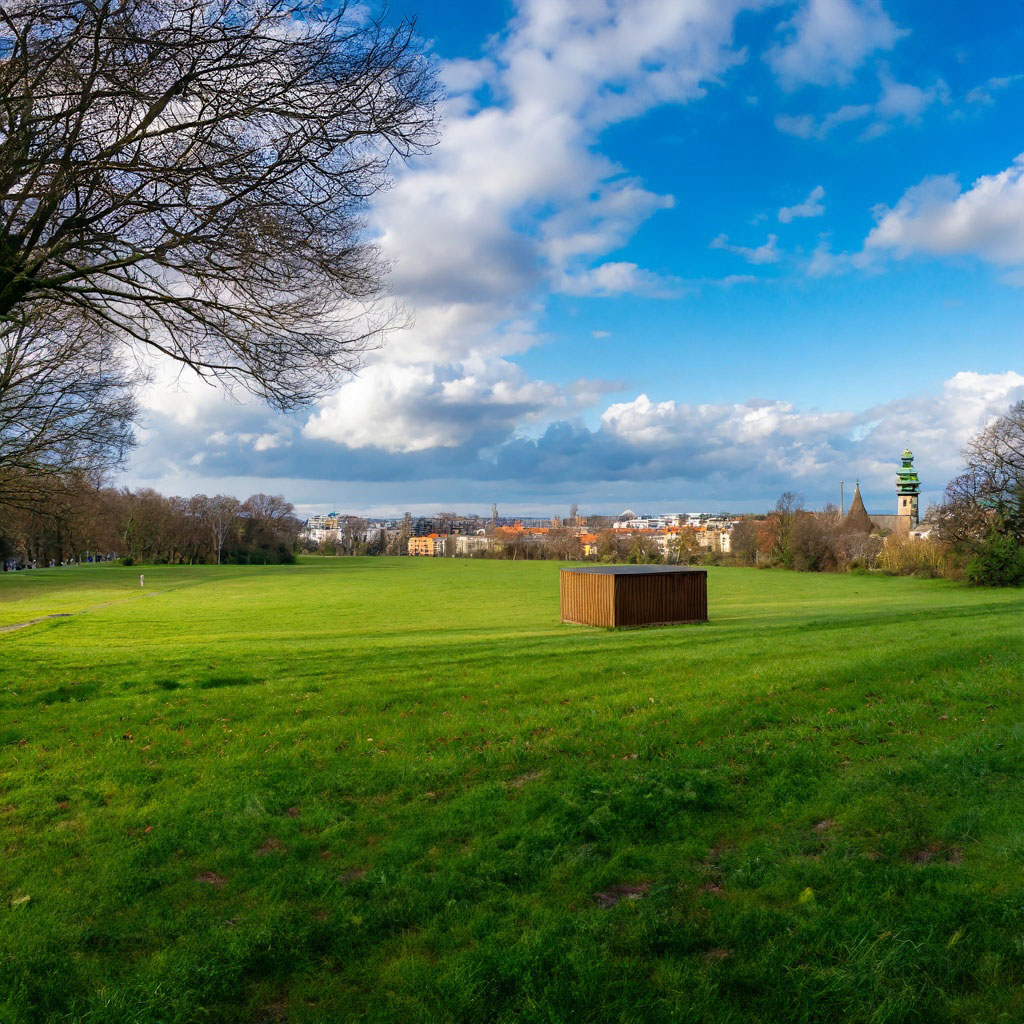
The well is drilled using the same method as is used in oil drilling. A drilling rig with a 40-meter-high derrick is set up. In terms of area, the fenced site occupies about the same space as a football field. The “drill” that performs the well drilling is located in the derrick. The well has a diameter of approximately 1 meter at the surface. Drilling is carried out in sections, with each section gradually decreasing in diameter with depth. The drilling itself reaches 4–5 km of depth, with a horizontal stretch of 2–3 km. The drilling takes about three months and is conducted around the clock.
In addition, equipment needs to be transported to and from the site, and pipes need to be installed to connect the new facility to the district heating network.
Overall, establishing the well will take approximately six months if everything proceeds according to plan.
Drilling the well takes about three months. The full construction period with site activity will last about six months.
We expect the facility to be completed in 2027.
As part of the demonstration project, seismic surveys will be conducted in and around Storvorde before drilling can take place. The purpose is to obtain a detailed understanding of the subsurface conditions to ensure that the well is positioned in the most optimal and technically sound location.
The surveys are carried out by GEUS (Geological Survey of Denmark and Greenland). In practice, small trucks will drive along existing roads in the area and transmit controlled pressure waves into the ground. These waves are reflected by geological layers in the subsurface and recorded for further analysis.
The activity may be briefly noticeable as minor vibrations, comparable to those caused by a passing truck. The truck only passes the same place once. The surveys are harmless to people, buildings and the environment and are conducted without any physical intervention in the subsurface.
As an additional precaution, COWI will document the condition of nearby buildings before and after the surveys and carry out vibration measurements at selected locations.
The surveys will place in March and April 2026. You can track the progress of the seismic trucks via an interactive map here.
During the drilling phase, the construction site will experience increased traffic with trucks and large machinery.
Drilling the well is going to cause noise and possibly minor vibrations, without any risk to the surrounding buildings. Green Therma will work with the rig owner to explore options for soundproofing the components that are the primary sources of noise. Green Therma will involve the affected residents to examine possibilities for temporary noise barriers, soundproofing bedrooms, relocation, etc.
In addition, there will be lighting on the construction site. Drilling takes place over three months, and work on the site continues around the clock.
Green Therma’s project manager, Mads Sylvest Eegholm
No, the facility does not use much electricity. A circulation pump with a power of up to 50 kW is the main electricity-consuming component, which should be held up against the heat production capacity of up to 2 MW.
When completed, the facility will take up no more space than a 20-foot container, housed in a small building.
We expect the facility to have a capacity of up to 2 MW. Aalborg Forsyning will purchase the heat, which is integrated into the overall heat supply.
No. The drilling takes place under very controlled conditions, and the area will be cordoned off while it is underway.
Once the facility is completed, it takes up very little space on the surface and can fit into a small technical building equivalent to a container. Most of the system is underground.
Once the facility is completed, it will have minimal CO₂ emissions due to its very low electricity consumption.
The water circulates in a closed system, so there is no risk of an environmental impact.
Aalborg Forsyning: Rents out Industrivej 12G to Green therma and purchases the heat from the facility through a 30-year heat agreement.
Aalborg University: Analyzes and assesses new energy technologies for the green energy transition
Aarhus University: Conducts geological studies supporting new technology development, implementation, and commercialization
GEUS (The Geological Survey of Denmark and Greenland): Conducts seismic surveys and develops geological models that provide crucial knowledge for the drilling operations.
Energy Cluster Denmark: Manages funding compliance, reporting, networking, and dissemination

Any questions?
Contact project manager Mads Sylvest Eegholm at +45 51 49 22 04 eller e-mail mse@greentherma.com.